
For readers outside China: what is Roundtable Pai?
Roundtable Pai (圆桌派, often translated simply as Roundtable) is a Chinese-language long-form conversation program hosted by Dou Wentao. Rather than building episodes around games, confrontation, or a promotional interview, it places several people at a table and lets a subject unfold through digression.
That sounds modest, but the eighth season shows why the program is better understood as a composed work. The host’s choice of guests, the order of ideas, the physical setting, and the willingness to leave uncertainty intact matter as much as any individual answer. The official season is available through Youku; availability and subtitles vary by region.
For viewers who do not speak Chinese, the larger lesson still travels well: a conversation can be carefully made without feeling manufactured.
Sincerity without turning life into a performance
Several Season 8 guests have accomplished things television could easily inflate into heroic narratives. Hu Anyan worked as a delivery courier and wrote about labor and his interior life. Lei Diansheng spent years walking across China and later followed a route associated with the Buddhist traveler Xuanzang.
What makes their appearances memorable is not the scale of those experiences. It is the absence of self-mythology. Work remains work; difficulty is not polished into inspiration; a remarkable journey does not require the traveler to present himself as remarkable.
Modern media often confuses sincerity with disclosure. A person reveals something painful, and the revelation itself becomes proof of authenticity. These conversations suggest a stricter definition: sincerity means allowing facts to remain awkward, incomplete, or unimpressive when that is what they are.
Liu Jiakun: compromise can become architecture
Architect Liu Jiakun was awarded the 2025 Pritzker Architecture Prize, the profession’s most internationally recognized honor. A conventional prestige interview might invite grand theories about material, form, and symbolism. His Season 8 conversation repeatedly returns those ideas to practical conditions.
Rough concrete can emerge from what local labor and construction methods can realistically produce. A round element may answer an existing maintenance structure rather than encode a mysterious philosophy. A celebrated architect can admit that parts of his education still feel unfinished.
None of this diminishes design. It reveals a different kind of intelligence: the ability to absorb a constraint so completely that it becomes part of the work’s character.
The useful design lesson: “Compromise” is not always the point where an idea fails. Sometimes it is the point where an abstract idea finally meets a real place, real workers, real materials, and real use.
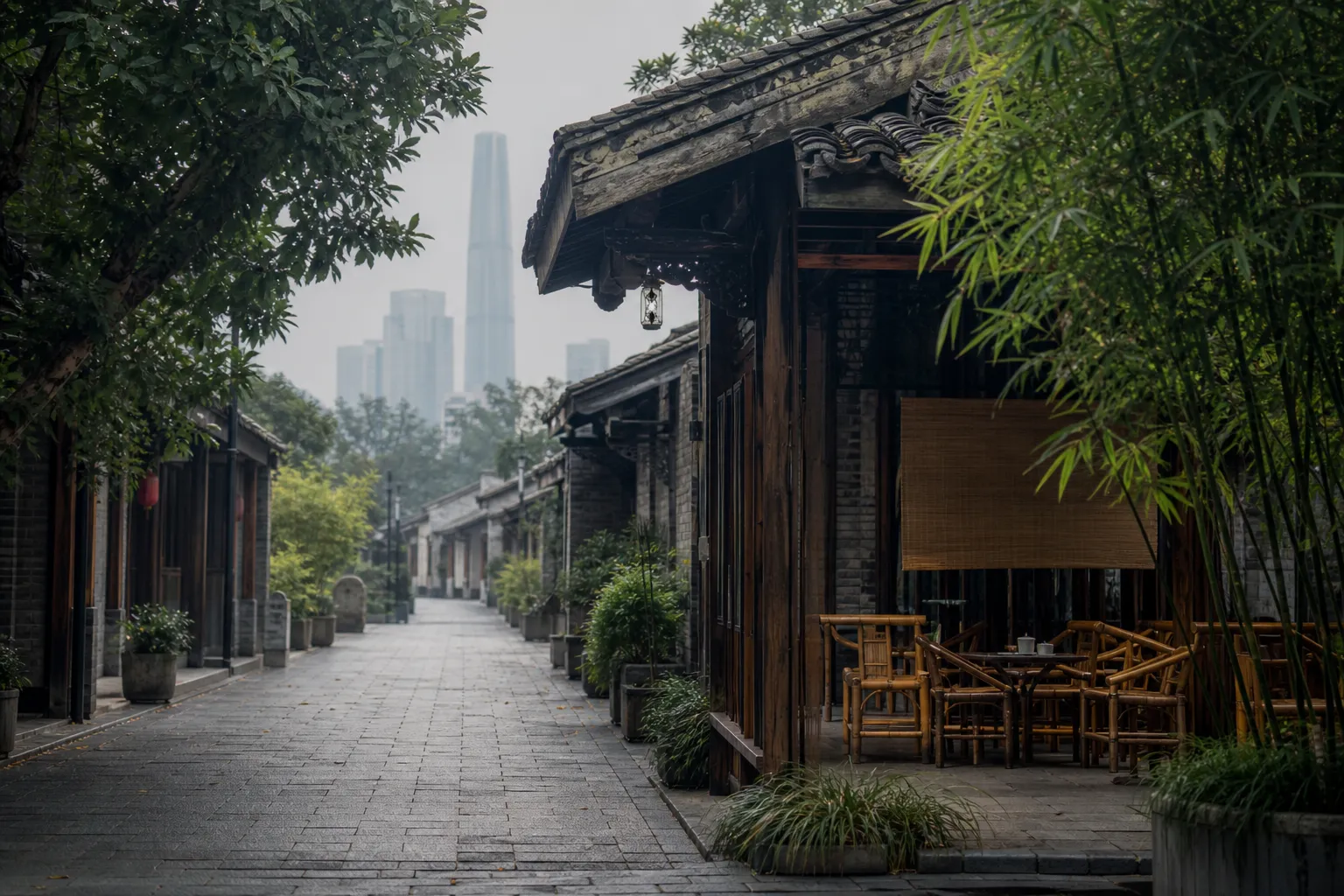
This is especially resonant in Chengdu, where Liu established his practice and produced works attentive to public life, memory, and local material conditions. The city is not merely where the conversation happened; it is part of what the conversation means.
Wang Di and history from below
Historian Wang Di studies street culture, teahouses, public space, and ordinary people in Chengdu. His English-language books include The Teahouse, The Teahouse under Socialism, and Street Culture in Chengdu. The University of Macau, where he is a chair professor, describes his approach as using daily experience to understand broader social change.
That is microhistory’s power. A dynasty, war, or political movement can be described from the top through rulers, institutions, and official documents. But a teahouse ledger, street argument, worker’s recollection, or household object can show how those forces entered ordinary life.
Neither scale is sufficient alone. History from above explains decisions and systems; history from below reveals consequences, improvisations, and the texture of living through them.
Why Pompeii feels so immediate
Pompeii is moving not only because a catastrophe preserved it, but because what survives includes shops, bakeries, advertisements, graffiti, houses, streets, and bodies. UNESCO describes Pompeii and Herculaneum as exceptional evidence of typical Roman life, preserving urban, decorative, and daily-life dimensions together.
The site collapses the emotional distance between “Roman civilization” and individual people who bought food, operated businesses, decorated rooms, complained, desired, and passed through a particular day. Their ordinariness is precisely what makes the past recognizable.
What would an ordinary people’s museum preserve?
Imagine a museum of Chinese history organized not around imperial splendor or famous battles, but around how people made a living and a home. Its most revealing objects might be:
- A worn delivery bag and the route notes of a courier
- A teahouse bill, stool, kettle, or staff roster
- A rural roof tile marked by the craft of an unknown maker
- A factory lunch container, school notebook, ration coupon, or family letter
- An apartment repair, improvised tool, or object altered to serve a second life
Such a museum would not reject great art or political history. It would restore proportion. Emperors, architects, and intellectuals belong in history, but so do the workers who poured concrete, the customers who occupied public rooms, and the people whose names never entered an official record.
Digital life gives more people the means to preserve their own evidence, but volume is not the same as memory. Platforms disappear, formats become unreadable, algorithms bury quiet accounts, and private archives are lost. Recording ordinary history requires curation, context, consent, and durable preservation—not merely posting.
The season’s quiet achievement
Season 8 does not prove its sincerity by insisting that it is sincere. It creates conditions in which accomplished people can discuss contingency, ignorance, labor, and compromise without rushing toward a polished moral.
That may be why the season feels like a high point. It does not make ordinary people interesting by turning them into celebrities. It treats ordinary life as already worthy of attention.
For another essay drawn from the same season, read How Should Non-Experts Judge Experts?, on evidence and intellectual humility.
This independent cultural essay discusses themes from a Chinese-language television program without reproducing its dialogue. Episode availability, numbering, subtitles, and regional access can change. Biographical details were checked against Youku, the Pritzker Architecture Prize, and the University of Macau on July 16, 2026.