
First: China Airlines is not Air China
China Airlines is the Taiwan-based SkyTeam carrier with airline code CI and a plum-blossom logo. Air China is a separate mainland Chinese Star Alliance airline with code CA. This review covers China Airlines on Seattle–Taipei, followed by a Taipei–Shanghai connection.
The distinction matters when searching fares, checking baggage, or finding the correct airport counter. Look for CI flight numbers and china-airlines.com.
Quick verdict
| Overall rating | 4.5 out of 5 |
|---|---|
| Aircraft reviewed | Airbus A350-900 on Seattle–Taipei |
| Best features | Fixed-shell seat, attentive service, strong catering, and an easy Asian connection network |
| Main weakness | The contracted Seattle lounge was ordinary during this trip |
| Best seat | Front-row/bulkhead when its extra space outweighs the usual bulkhead tradeoffs for you |
Bottom line: a highly competitive way to reach Taiwan or connect onward to East Asia without paying business-class prices.
What I paid—and how to compare fares
My cash itinerary from Seattle to Shanghai via Taipei cost about US$900 in premium economy for the long-haul segment. That was an unusually attractive fare during the booking period, not a price readers should expect to reproduce.
I booked through the American Express Platinum International Airline Program. The program can surface preferred fares on selected premium-economy, business, and first-class itineraries with participating airlines. Savings vary by country of card issuance, airline, route, fare class, and date. It is not a universal 10% discount.
Compare the Amex Travel result with the identical itinerary sold directly by China Airlines. Check:
- Total price, not the percentage displayed
- Change and cancellation rules
- Seat-selection fees
- Which segment is actually premium economy
- Who services the ticket during disruption
China Airlines’ current premium-economy fare-family page lists different Basic, Standard, and Flex conditions and currently shows two checked pieces up to 28 kg each on eligible all-China-Airlines itineraries, but partner segments and routes can alter the rule. Trust the allowance printed on your ticket.
The lounges: Seattle and Taipei were worlds apart
Seattle: The Club at SEA
I used The Club at SEA rather than a Delta Sky Club. It provided a seat, refreshments, and a quieter place to wait, but the food and overall experience were modest.
The Club at SEA is a shared-use lounge. The Port of Seattle lists locations near A12 and above S10, while The Club accepts methods including prepaid passes and eligible third-party memberships such as Priority Pass, subject to capacity and current rules.
A premium-economy ticket does not necessarily include lounge entry. I had access on this trip, and eligible airline-contracted guests were being processed differently from Priority Pass walk-ins. Confirm the lounge invitation on your boarding pass or with China Airlines; do not assume another flight will work the same way.
Taipei: Dynasty Lounge
China Airlines’ Dynasty Lounge at Taoyuan felt substantially better: more space, Taiwanese small dishes, hot and cold drinks, dim sum, and freshly prepared beef noodles. It was worth allowing real connection time rather than treating it as a quick coffee stop.
Again, access depends on cabin, status, invitation, or another qualifying method. Standard premium economy alone should not be treated as a guaranteed lounge entitlement.
We also compared the airport’s main card-access options in our Taoyuan Airport lounge guide, including Oriental Club, Plaza Premium, and China Airlines’ own lounge.
The A350 fixed-shell premium-economy seat
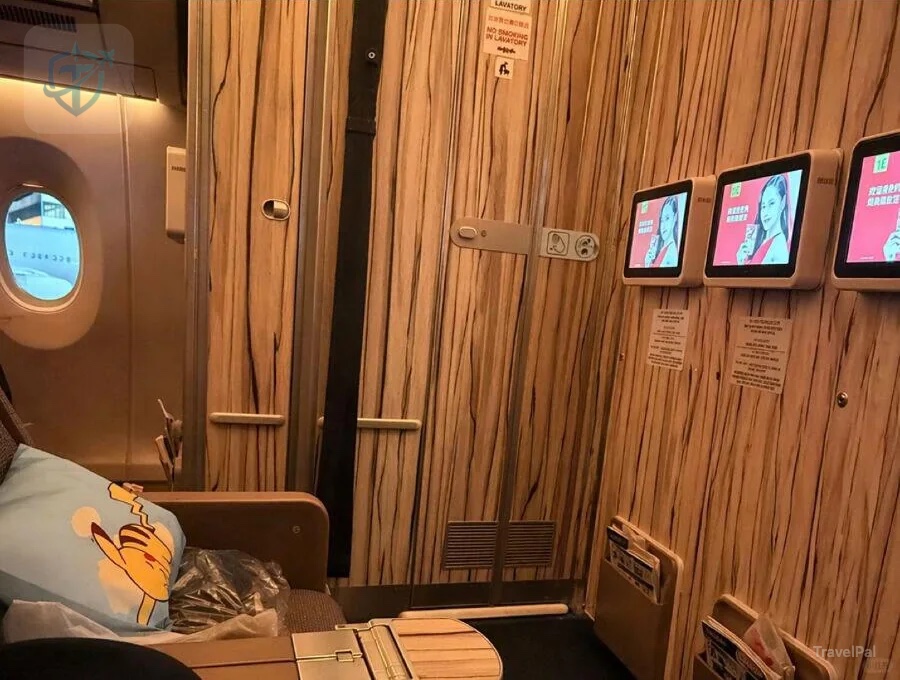
China Airlines uses an Airbus A350-900 on the Seattle–Taipei route in the reviewed configuration. The airline’s official material describes 31 premium-economy seats and a cabin finished in its signature persimmon wood-grain aesthetic.
The key feature is the fixed shell. When reclining, the seat moves within its own structure instead of pushing the seatback deeply into the next passenger’s space. That removes the familiar negotiation with the person behind you and preserves a predictable personal area.
It is not lie-flat, but it was comfortable enough for several hours of genuine sleep. The wood-grain surfaces and warm lighting also make the cabin feel calmer and more distinctive than a standard economy section.
Should you choose the first row?
The first row offered excellent legroom on this flight and would be my choice again. But bulkhead seats can have drawbacks: fixed armrest tables, screens stored away for taxi and landing, no under-seat bag during those phases, proximity to galleys or lavatories, and possible bassinet positions. Review the exact seat map and recent aircraft configuration before paying.
Aircraft substitutions happen. China Airlines plans to begin introducing upgraded A350 cabins in 2027, so this specific product will not describe every future Seattle flight.
Service, meals, and amenities
Service was attentive from boarding through arrival. Crew checked proactively, communicated warmly in Mandarin, and made the cabin feel cared for without becoming intrusive.
On the long-haul segment, my Singapore-style omelet rice came with an appetizer, dessert, and Häagen-Dazs ice cream. The full tray was well above my expectations for premium economy. Even the relatively short Taipei–Shanghai flight served a proper meal during this itinerary.
Meal schedules and dishes change by date, departure station, and flight time. A short regional segment should not be booked on the assumption that a full meal is guaranteed.
My long-haul amenities included slippers, noise-reducing headphones, and a dental/travel kit. China Airlines currently advertises branded premium-economy travel kits, but contents and brand partnerships rotate; the onboard product is the authority.
Connecting in Taipei for Shanghai
Taoyuan is a practical one-stop gateway between Seattle and Shanghai. On a single through-ticket, follow international-transfer signs, confirm whether your checked bags are tagged to PVG, and verify the departure terminal and gate after security.
- Keep passport, any required travel documents, and the onward boarding pass accessible.
- Recheck Taiwan transit and mainland China entry requirements for your nationality and itinerary.
- Allow extra connection time if lounge dining matters to you.
- Do not assume the regional Taipei–Shanghai aircraft offers premium economy; cabin products vary by segment.
- On separate tickets, baggage collection and entry formalities may change the entire connection.
For this trip, the combination worked: a restful long-haul seat, consistently thoughtful service, strong food, and a comfortable transfer before the short final flight to Shanghai. At the right fare, I would choose China Airlines premium economy again.
For the Shanghai airport leg, see our luggage-tested guide to taking the Maglev from Longyang Road to Pudong Airport.
This independent review reflects one personally purchased itinerary. Fares, schedules, aircraft, seats, lounges, access rules, meals, amenities, baggage, card benefits, and immigration requirements change. Verify current details with China Airlines, American Express, airports, and relevant government authorities.