
Why Qianling is unlike Xi’an’s urban attractions
Qianling lies on Mount Liang in Qian County, roughly 80 kilometers northwest of central Xi’an. It is the joint mausoleum of Tang Emperor Gaozong, Li Zhi, and Wu Zetian—the only woman in Chinese history to rule under the title of emperor.
The Shaanxi Cultural Heritage Administration calls it the best-preserved of the province’s 18 Tang imperial mausoleums. Its scale is geographic: the mountain itself contains the unexcavated imperial burial chamber, while ceremonial architecture, stone sculpture, and satellite tombs occupy the surrounding landscape.
“The end of the Tang” is a compelling emotional description, but not a chronological one. Gaozong and Wu Zetian belong to the dynasty’s early and high period. What feels final is the site’s accumulated silence—the vanished court, damaged figures, sealed mountain, and later inscriptions laid over imperial intentions.
Set expectations correctly: You cannot enter Gaozong and Wu Zetian’s burial chamber. It remains unopened. The underground spaces visitors enter are excavated satellite tombs belonging to younger imperial family members.
The most efficient visit order
The official combined ticket covers a dispersed complex. The internal shuttle is worth buying unless you have your own vehicle and current rules allow point-to-point access. Our recommended order is:
- Princess Yongtai’s tomb and Qianling Museum
- Crown Prince Yide’s tomb
- The Qianling imperial core: spirit way, stone sculptures, steles, and mountain approach
- Crown Prince Zhanghuai’s tomb
This sequence moves from intimate court imagery to monumental state ceremony, then ends with another mural-rich tomb. Shuttle stops and temporary conservation work can change, so confirm the route with staff before boarding.
The three accessible satellite tombs
Princess Yongtai: the most atmospheric descent
Princess Yongtai, Li Xianhui, was a granddaughter of Gaozong and Wu Zetian and a daughter of the future Emperor Zhongzong. She died in 701 at about 16 years old by Western age reckoning—or 17 in the traditional East Asian count often used in Chinese descriptions.
Her tomb is among the largest and highest-status excavated Tang tombs for a woman. The long sloping passage, courtyards, vaulted corridors, and stone sarcophagus communicate hierarchy before any object label does.
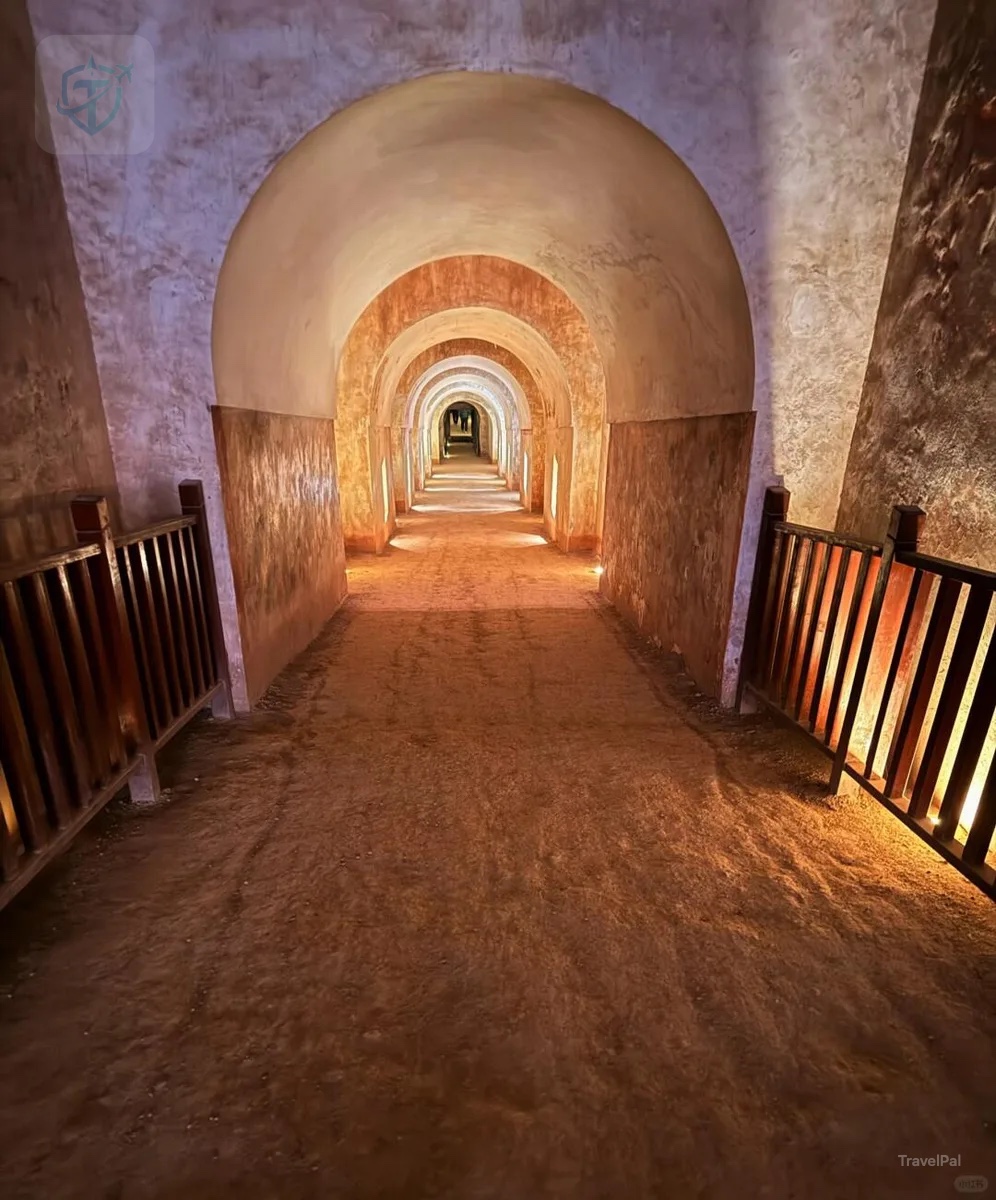
Many famous murals have been removed for conservation, and what appears in situ may include reproductions or protected remnants. That distinction does not make the spatial experience false—but visitors should not assume every bright court figure on the wall is the untouched original.
Crown Prince Yide: court order on a monumental scale
Li Chongrun, posthumously honored as Crown Prince Yide, was Yongtai’s brother. His burial has a similarly ambitious layout, with imagery that evokes palace architecture, guards, attendants, and celestial order. The visit feels more architecturally complete than a display case because the procession unfolds along the route toward the burial chamber.
Crown Prince Zhanghuai: movement and cosmology
Li Xian, Crown Prince Zhanghuai, was a son of Gaozong and Wu Zetian. His tomb is associated with celebrated murals including polo players and foreign envoys. The ceiling imagery also places sun, moon, and stars around the tomb’s ritual universe.
The original murals and objects are conservation-sensitive. Follow photography signs, avoid flash, and never touch painted or carved surfaces.
The imperial core: a state procession in stone
The central Qianling approach is the reason not to reduce this trip to “three tombs.” Along the ceremonial axis stand stone pillars, winged horses, ostriches, saddled horses with handlers, officials, two great steles, and the group traditionally called the Sixty-One Foreign Envoys.
The figures convey a Tang court that understood itself at the center of a wide diplomatic world. Many statues have lost their heads, and conservation enclosures may limit views, but the arrangement remains legible as political theater built into the landscape.
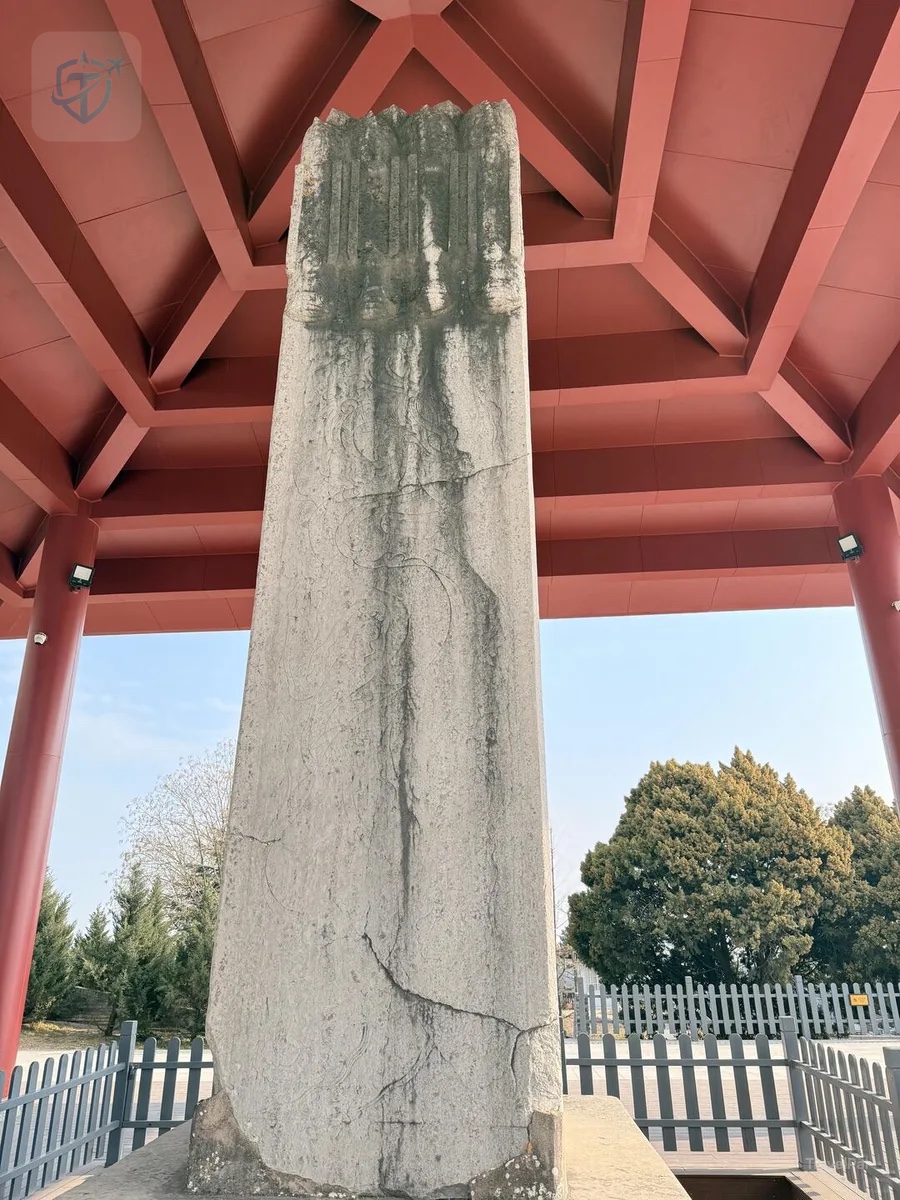
The Wordless Stele
Wu Zetian’s stele carries no original biographical inscription, inspiring centuries of interpretation: perhaps her achievements exceeded words; perhaps judgment was left to posterity; perhaps the unfinished inscription reflected political circumstances. No single romantic explanation is established fact.
The monument is not blank today. Later visitors carved inscriptions across it, including an important bilingual inscription from the Jin period. “Wordless” describes the absence of an original imperial eulogy, not a pristine empty surface.
The Stele of the Sage’s Deeds
Across the axis stands Gaozong’s commemorative stele, associated with a text composed under Wu Zetian. It supplies the written imperial praise that her own monument withholds. If conservation work covers either stele, do not assume the obstruction is permanent; check current notices.
Getting from Xi’an to Qianling
Qianling is a dedicated excursion, not a convenient detour. From central Xi’an, a car normally takes about 1.5 hours each way in good conditions, sometimes longer with traffic or pickup logistics.
Private car or hired driver
This is the simplest option for two or more people. Arrange the full round trip, waiting time, tolls, parking, and exact pickup point in writing. Do not assume a ride-hail driver will wait or that a return car will be immediately available in a rural tourism area.
Rail plus local transfer
Some itineraries use a train from Xi’an North toward Qian County followed by a taxi or local vehicle. Schedules, station names, and frequencies change; search the official China Railway 12306 system for your date before building the plan. The rail journey only helps if the departures align, because the final transfer still requires time.
Tour or public transport
A legitimate day tour can solve the return-transport problem, but confirm whether all satellite tombs, the shuttle, admission, and sufficient walking time are included. Seasonal tourist buses may operate, yet should not be assumed without same-day confirmation from the official site or Xi’an tourism service.
2026 tickets, hours, and the internal shuttle
| Item | Current official listing |
|---|---|
| March–November admission | ¥100 full price / ¥50 eligible reduced ticket |
| December–February admission | ¥80 full price / ¥40 eligible reduced ticket |
| Internal sightseeing shuttle | ¥20 per person |
| Peak-season hours | 8:00 a.m.–6:00 p.m. |
| Low-season hours | 8:30 a.m.–5:30 p.m. |
The official ticket page is Qianling Scenic Area online booking. Its spelling uses “shanxi” in the domain even though the site is in Shaanxi province.
On our winter visit, a passport required buying the ¥80 ticket at the window while some domestic-ID holders could use online channels. Foreign-document support can change. Bring the physical passport, allow extra time, and use the official consultation number shown on the site if online booking rejects the document.
How much time?
A focused visit may fit into four hours once inside, but a full day is more realistic after transport, shuttle waits, tomb descents, and lunch. The passages involve slopes, steps, low light, and uneven surfaces. Wear shoes with grip and bring water.
Should you combine Qianling with Famen Temple?
It is geographically possible by private car, but “possible” is not automatically pleasant. Combining both creates a long, structured day with substantial driving and little room for delays. History-focused visitors are better served by giving Qianling most of a day; combine the sites only with an early start, a driver, confirmed closing times, and a willingness to shorten one visit.
Food
Do not make the trip for destination dining. Qian County is a practical lunch stop for noodles, steamed buns, or other local staples. Carry a snack so an inconvenient meal does not force you to rush a tomb or accept the first option inside the scenic area.
Bottom line
Qianling is far, spread out, and not designed for effortless photographs. That is exactly why it can be more affecting than a central-city attraction. The site asks you to move through the hierarchy of a vanished court—from private burial chambers to an avenue of diplomats and officials, then toward a mountain that still withholds its rulers.
Go for the landscape and the sequence, not merely the Wordless Stele. With enough time, the day becomes less a checklist of Tang relics than an encounter with how a dynasty imagined memory, power, and judgment after death.
For another major excursion, use our complete Terracotta Army and Lishan Garden guide. For a central Xi’an alternative, read our Xi’an Museum and Small Wild Goose Pagoda review.
Admission, hours, shuttle operation, passport ticketing, train schedules, open satellite tombs, displays, and conservation closures can change. This firsthand guide reflects a winter visit; details were checked against Qianling Scenic Area and the Shaanxi Cultural Heritage Administration on July 16, 2026.