
The best sequence: temple first, city spectacle second
Giant Wild Goose Pagoda sits inside Daci’en Temple, but the surrounding district now contains several different experiences: a working Buddhist temple, a UNESCO-listed tower, public plazas, a musical fountain, parks, restaurants, and the illuminated Grand Tang Mall pedestrian district.
Do not start late at night if the historic site matters to you. The public spaces remain active after the temple closes. A practical order is:
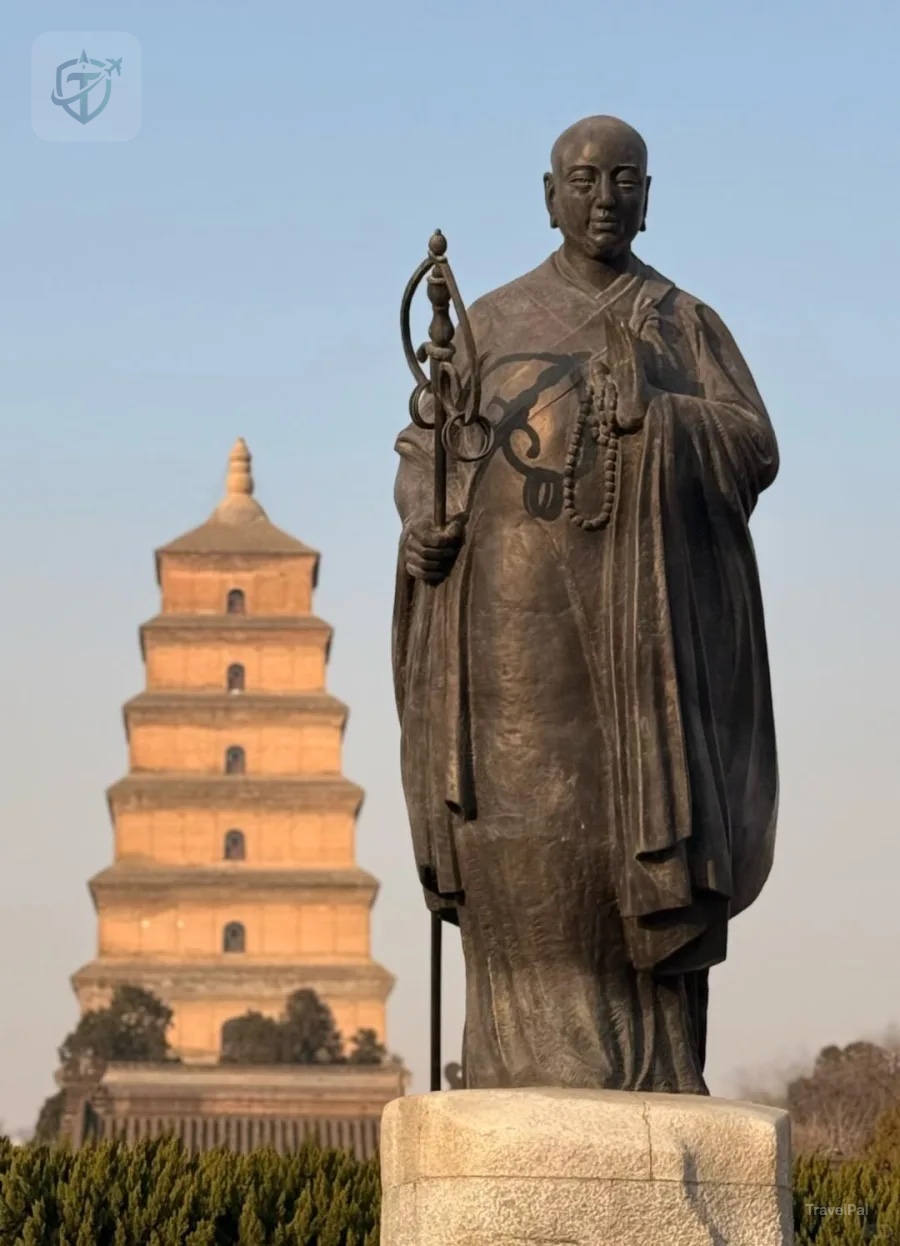
- 3:00–3:30 p.m.: arrive at the South Square and photograph Xuanzang with the pagoda
- 3:30–5:00 p.m.: enter Daci’en Temple and study the pagoda base, courtyards, and Xuanzang displays
- Before last tower admission: climb only if the stairs and view appeal to you
- Golden hour: walk the exterior gardens and photograph the brickwork in warm light
- After sunset: continue north for the fountain if operating, or south through Grand Tang Mall
Adjust the starting time seasonally. Winter sunset and temple closing arrive earlier; summer heat makes a later start more comfortable but reduces your margin before last admission.
Xuanzang was more than the model for a novel
Daci’en Temple was founded in 648 by Crown Prince Li Zhi—the future Emperor Gaozong—in memory of his mother, Empress Wende, from the Zhangsun family. Xuanzang became its first presiding monk and led a major Buddhist translation center here.
He had returned to Chang’an in 645 after years of travel through Central and South Asia. The popular Journey to the West transformed that journey into mythology centuries later, but Xuanzang’s historical achievement needs no monkey king: he mastered textual traditions, translated an enormous Buddhist corpus, developed the Chinese Yogācāra school with his disciples, and preserved geographic and cultural observations in the Great Tang Records on the Western Regions.
That 12-volume record describes places, routes, customs, political conditions, and religious life across regions he visited or learned about. Historians value it as evidence—not as a transparent modern travel report, but as an extraordinarily important source for studying early medieval Central and South Asia.
Why the pagoda was built
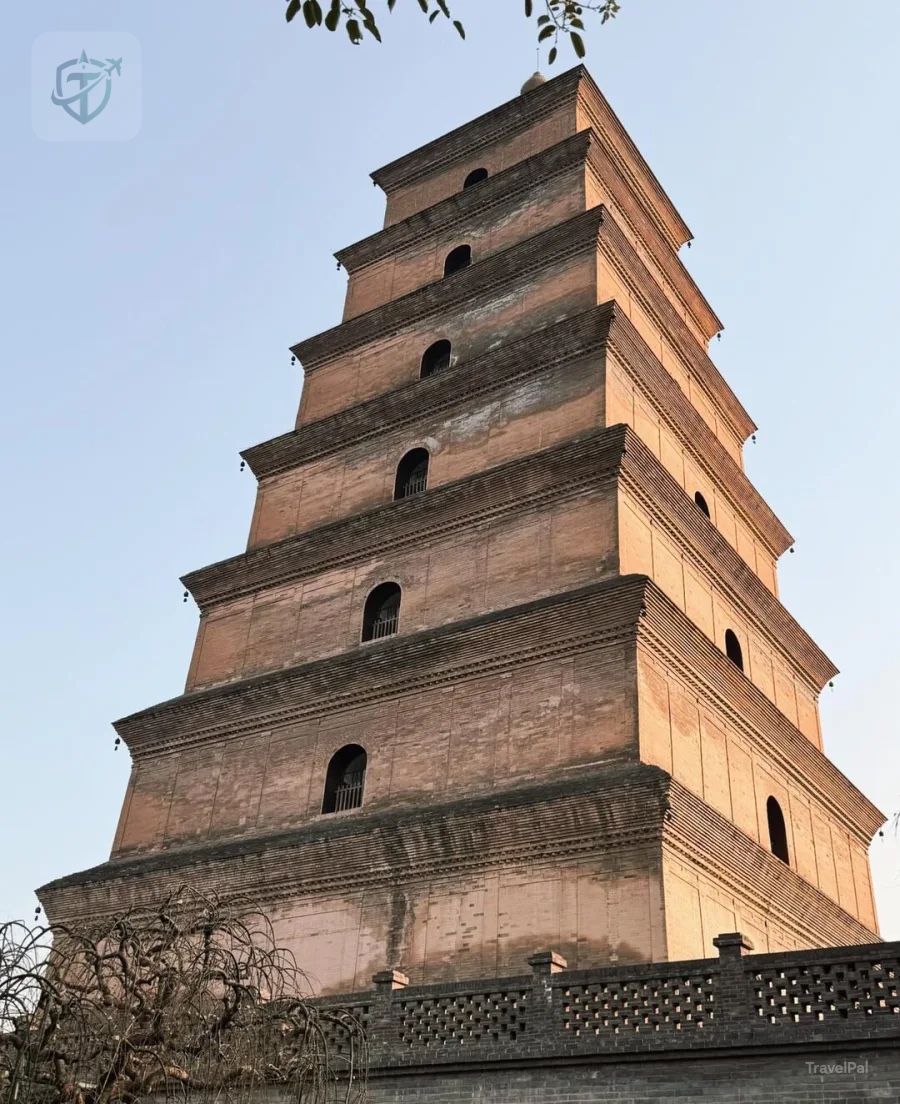
Xuanzang requested the pagoda in 652 to house scriptures, Buddhist images, and relics brought from India. The first structure had five stories and a different construction. Rebuilding during Wu Zetian’s reign and later repairs transformed it; the seven-story, tapering brick monument visitors see today also carries major Ming-period work.
In 2014 the pagoda became part of the transnational UNESCO property “Silk Roads: the Routes Network of Chang’an–Tianshan Corridor.” The Shaanxi Cultural Heritage Administration emphasizes its role in preserving scriptures and images brought along the Silk Road. Its value is not simply age: it materializes the movement of texts, people, and architectural ideas.
What deserves attention inside Daci’en Temple
The Xuanzang narrative
Temple exhibitions and murals outline the historical journey and translation work. Some displayed manuscripts and palm-leaf scriptures are reproductions; treat them as teaching tools, not automatically as objects carried by Xuanzang himself. They help explain how Buddhist texts circulated across languages and writing materials.
The two imperial inscriptions
At the pagoda’s ground-floor south doorway, two stone steles preserve texts composed by Tang Taizong and Gaozong in honor of Xuanzang and his translations. Both were written in calligraphy by Chu Suiliang. They are commonly known together as the “Two Sages and Three Perfections” steles, joining imperial authorship, celebrated calligraphy, and Xuanzang’s Buddhist achievement.
These are not the same object as the famous Preface to the Sacred Teachings assembled from Wang Xizhi characters at the Xi’an Beilin Museum. If calligraphy is your priority, the Beilin collection provides a broader and easier comparative visit; at the pagoda, appreciate the Chu Suiliang inscriptions in their architectural and religious setting.
Should you pay to climb the pagoda?
Our answer is optional, not essential. The tower climb is a separate purchase after entering Daci’en Temple. Its main rewards are the physical experience of entering a historic pagoda, elevated views across modern Xi’an, and a closer sense of the structure.
Skip it if you expect rooms filled with original treasures. Interior interpretation includes modern material and reproductions, while the stairs can feel narrow, repetitive, and crowded. The pagoda’s strongest visual impact remains outside, where the full tapering form is legible.
Climb if: historic architecture, stairs, and city views appeal to you. Skip if: you have limited mobility, dislike confined crowds, or mainly want photographs and original museum objects.
Where to take the best photographs
- South Square: frame Xuanzang’s statue against the pagoda. A moderate telephoto perspective compresses the two cleanly.
- Temple courtyards: use gates, incense burners, and rooflines to layer the tower within its religious setting.
- Side gardens: late-afternoon light reveals brick texture better than flat midday sun.
- North Square: step back for symmetry, reflections when the water is operating, and a more urban composition.
You do not need admission merely to photograph the pagoda. Both public squares provide strong exterior views. Enter the temple for history, religious space, and closer architectural context—not because the only photograph is inside.
2026 tickets, hours, and transport
Daci’en Temple admission and pagoda climbing are separate. Recent 2026 visitor listings show a reduced temple ticket of about ¥10 and a tower ticket around ¥25, but other current pages still display the older ¥40 temple rate. That conflict suggests a recent or promotional pricing change rather than a reliable permanent tariff.
Use the official Daci’en Temple WeChat mini-program on your visit date for the live temple price, entry window, and last admission. Tower tickets are generally purchased separately inside the temple. Do not buy an expensive third-party “official” package without checking what it actually includes.
Typical listings place temple access roughly between 8:00 or 8:30 a.m. and 5:30 p.m., with sales or entry stopping earlier. Tower access can close before the wider complex. Seasonal, maintenance, religious-event, and holiday schedules can override those hours.
Getting there
Take Xi’an Metro Line 3 or 4 to Dayanta station. Exits B and C serve the North Square side; follow station and street signs for your chosen starting point. The district is walkable once you arrive, but the distance from the North Square through the temple area and down Grand Tang Mall adds up.
North Square fountain and Grand Tang Mall
Do not build the whole evening around an old fountain schedule
The North Square musical fountain is a major urban installation, but performance times change with season, weather, maintenance, crowd control, and special events. Search the current notice from the Giant Wild Goose Pagoda cultural scenic area or Qujiang authorities on the same day. Arrive early if a performance is confirmed; the central viewing areas fill quickly.
If the fountain is canceled, the evening is not lost. The lit pagoda and broad public square still work as a transition from the quiet temple to the modern city.
Grand Tang Mall after dark
South of the pagoda, Grand Tang Mall is a long, free pedestrian entertainment district—not an archaeological reconstruction of Tang Chang’an. Expect monumental lighting, Tang-inspired costumes, public art, food, retail, and scheduled street performances.
It can be extremely crowded on weekends and holidays. Treat it as contemporary cultural theater, keep valuables secure, agree on a meeting point if traveling with others, and leave by a side street or farther metro station if the central corridor becomes uncomfortable.
Bottom line
Giant Wild Goose Pagoda works best as a transition across time: Xuanzang and Tang Buddhist translation in the afternoon, warm light on a rebuilt ancient tower near sunset, then present-day Xi’an performing its idea of Tang splendor after dark.
You do not have to climb, and you should not trust a copied fountain timetable. Enter Daci’en Temple for the history and inscriptions; photograph the pagoda from the ground; then let the public squares and Grand Tang Mall extend the visit naturally into evening.
For the related UNESCO-listed companion, read our Small Wild Goose Pagoda and Xi’an Museum guide. For a deeper museum day, see Shaanxi Archaeology Museum. Staying in southern Xi’an? Our Hyatt Regency Xi’an review explains the Qujiang location tradeoffs. To connect these stops into one trip, use our six-day Xi’an itinerary.
Temple and tower prices, opening hours, tower access, mini-program availability, fountain performances, street shows, lighting times, and crowd-control measures can change. Historical details were checked against Shaanxi cultural-heritage and local-history sources; practical details were reviewed on July 16, 2026. Confirm the official same-day notice before traveling.