
The official 2026 ticket process
Shaanxi History Museum’s main permanent exhibition is free, but entry is timed and advance reservation is essential. The museum currently releases main-building tickets five days ahead at 5:00 p.m. China time. For example, tickets for the 15th become available on the 10th.
Use the official “Shaanxi History Museum” WeChat account. The system lets you pre-fill up to five visitors, which saves critical time—but pre-filling is not a reservation. Return at release time, open the saved information, choose a session, tap the reservation button, and confirm that a successful order appears.
- Open the museum’s official WeChat reservation system before release day.
- Add each visitor’s exact legal name and document number.
- Check the desired date’s release time in China.
- At 5:00 p.m., enter through the saved-information query rather than typing everything again.
- Complete the booking and verify it under successful orders.
Do not pay an agency for a “pure reservation.” The museum says it has not authorized any third-party platform, travel agency, or person to sell its free tickets or bundle them with paid services. Use the museum’s official account.
Missing the slot has a real consequence
Your ticket is valid only for its stated entry window. The museum explicitly says it will not admit visitors early or late. Bring the original identity document used to reserve and leave enough time for security and the correct entrance.
If plans change, cancel before your slot stops admitting visitors. An uncanceled no-show triggers a 180-day booking suspension under the current rules. That is a good reason to release a ticket you cannot use.
Foreign visitors can reserve with a passport
The system accepts a passport, Mainland Travel Permit for Hong Kong and Macao Residents, Mainland Travel Permit for Taiwan Residents, or Chinese permanent-resident card in addition to a mainland identity card.
Bring the original document entered during booking. The museum’s older detailed FAQ directs visitors using non-mainland documents to exchange the reservation at the comprehensive service window on the east side of the south entrance; the current guide emphasizes identity-document verification. Follow the instructions in your successful order and allow extra time at the service window rather than joining the ID-card gate blindly.
A legitimate alternative: book an eligible paid exhibition
The museum currently states that visitors who buy an eligible paid-exhibition ticket online do not need a separate free main-museum reservation. This is the official alternative when free sessions disappear—not an agency workaround.
In July 2026, the paid options listed by the museum include the Tang Dynasty Mural Treasures Gallery and the temporary exhibition on Hellenistic gold art. Exhibitions and prices change, so confirm that the checkout page explicitly includes entry to the main museum before paying.
The Hejiacun treasure exhibition, Great Tang Treasures, is currently listed as a long-term exhibition in Hall 4 and was open in the museum’s June 2026 holiday notice. Its access policy has changed over time, so check the current reservation product rather than assuming an old free or paid rule.
How to escape the tour-group wave
Our most useful discovery happened after entering. Nearly everyone stopped at the first famous Western Zhou bronzes while guides formed dense semicircles around the cases. Instead of fighting for the same sightline, we moved ahead and slowed down later.
Tour groups tend to travel in pulses. A gallery that is impossible at the beginning of one admission session can become calm shortly before the next wave arrives. Use that rhythm:
- Do not anchor at the first masterpiece. Note its location and return later if circulation permits.
- Move one gallery ahead of the largest group. Study quieter objects while the crowd is still listening behind you.
- Pause between chronological sections. Let a fast group pass rather than trailing it case by case.
- Photograph last, look first. Waiting 10 minutes often produces a cleaner view without pushing.
Once admitted, you can generally remain until closing; the timed window controls entry, not a fixed 90-minute visit. Protect three or more hours so you can use patience as a crowd-management tool.
Do you need a guide?
A good guide adds context, but joining the largest on-site group also fixes your speed to the crowd. The museum offers official guides, audio devices, and sometimes volunteer interpretation. Another effective approach is to study the museum’s official collection pages or full-gallery virtual tours beforehand, then explore independently.
Avoid relying on an unsourced video as the final authority. Artifact interpretation changes, exhibits rotate, and confident online narration can be wrong. Use pre-visit media to create questions, then compare it with the label and museum sources.
What to prioritize
The permanent sequence: Zhou, Qin, Han, and Tang
The main exhibition uses archaeology and art to explain the dynasties and cultures rooted in Shaanxi. Western Zhou ritual bronzes make political hierarchy tangible; Qin material shows the formation of an imperial system; Han objects expand the world of tomb, court, and long-distance exchange; Tang galleries deliver cosmopolitan color, metalwork, ceramics, and figures.
Do not reduce this to a greatest-hits hunt. A bronze inscription, an ordinary tomb figure, or a change in vessel form can explain more history than the most photogenic object when read in sequence.
Hejiacun: Tang wealth and cultural exchange
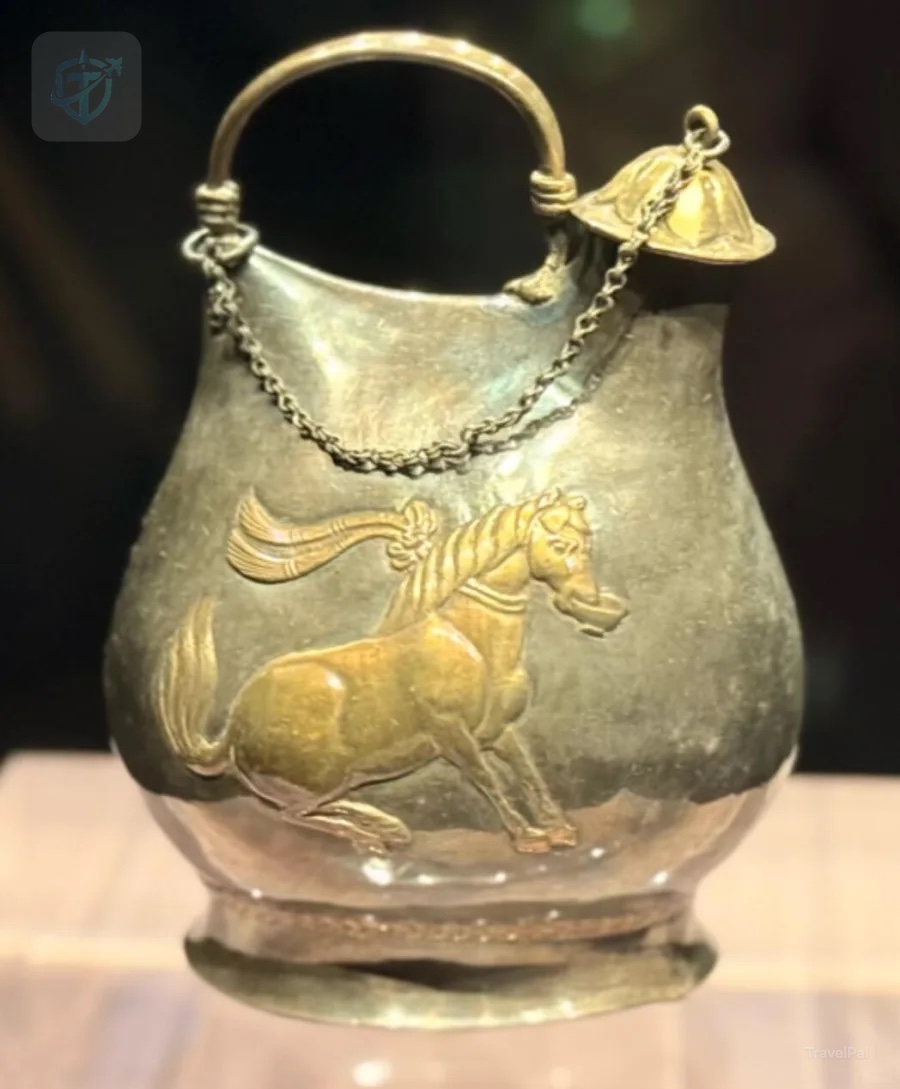
The Hejiacun hoard was discovered in southern Xi’an in 1970. The museum’s reworked exhibition presents hundreds of selected pieces through court institutions, dining, dress, leisure, exchange, and technology.
The gilt silver dancing-horse ewer combines a northern nomadic bag-shaped vessel with Tang court imagery. A horse on each side kneels with a cup, recalling trained dancing horses used in Emperor Xuanzong’s birthday celebrations. The object is not just luxurious metalwork; it materializes cultural exchange and court performance.
Displays rotate. The museum’s collection database may mark a famous object “not on display” even when it appeared during an earlier visit or in another official listing. Never promise yourself one masterpiece without checking current exhibit information.
The camel musicians
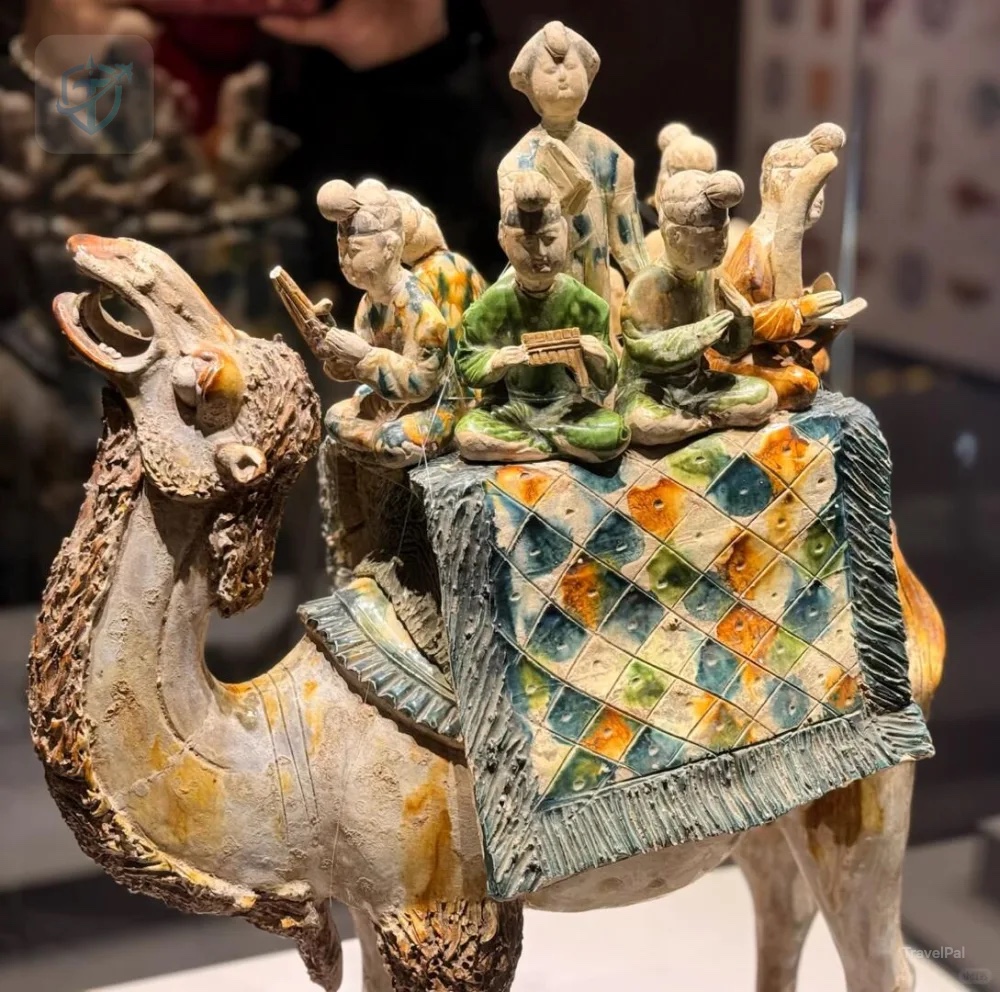
The Tang sancai camel supports a platform of musicians around a standing singer. Its theatrical improbability is part of its appeal: camel transport, foreign-facing trade routes, performance, costume, and brilliant lead glazes combine into an image of a mobile, cosmopolitan world.
Tang mural gallery
The paid mural gallery contains exceptionally fragile paintings removed from elite Tang tombs. It is worth considering when conservation, painting, clothing, architecture, diplomacy, or court ceremony matters to you. Some related displays may close for equipment upgrades even while the main mural gallery remains open, so read the current notice carefully.
Current hours, closure day, and transit
For May 6 through November 14, 2026, the main museum currently lists extended hours of 8:30 a.m.–7:00 p.m., with final entry at 6:00 p.m.. Holiday hours receive separate notices. The museum is normally closed Monday except national public holidays.
Winter hours and future seasonal schedules can differ, so an “off-season guide” should begin with the museum’s live visitor guide, not a copied annual timetable.
The main museum is at 91 Xiaozhai East Road. It is roughly 778 meters from Xiaozhai station on Metro Lines 2 and 3, or about 834 meters from Dayanta station on Lines 3 and 4. Either is workable; choose based on your preceding stop and the entrance instructions in your booking.
Main museum versus the Qin–Han branch
Shaanxi History Museum now has two physically separate sites. This guide covers the famous main museum near Xiaozhai and Giant Wild Goose Pagoda.
The Qin–Han branch lies in Xixian New Area near Qingong station on Metro Line 14. As of the current 2026 guide, visitors can enter that branch with an original valid identity document without advance reservation. Its displays focus on Qin and Han civilization, and it is not a backup entrance to the main building.
Bottom line
Shaanxi History Museum is worth the booking friction because few museums connect the political and artistic worlds of Zhou, Qin, Han, and Tang with comparable depth. But a successful visit depends on refusing shortcuts: use the official account, reserve at release time, carry the exact document, and arrive within the slot.
Inside, stop treating the crowd as your itinerary. Move ahead, pause, circle back where possible, and let guided groups pass. The museum becomes far more rewarding when you give individual objects time instead of competing for the same photograph.
For a quieter institution focused on archaeological process, read our Shaanxi Archaeology Museum guide. For the nearby evening, continue to the Giant Wild Goose Pagoda.
Ticket release rules, entry sessions, opening hours, paid exhibitions, prices, gallery closures, document procedures, and displayed objects can change. Details were checked against Shaanxi History Museum’s official visitor guide and June–July 2026 notices on July 16, 2026.