
I should start with a confession: I know very little about AI, and almost nothing about AGI. The more I read and the more I use frontier models, the less I feel I understand the boundary between the two. Every confident definition seems to move when the technology moves.
Broadly, I think of AGI as a system that can do at least everything a human can do with human cognitive ability. It does not need to physically clean a house or serve a meal like a robot. The question is whether it can think, learn, reason, create, and solve problems as well as—or better than—a human across the full range of things humans do.
Why I do not believe we have AGI yet
My first hesitation is technical. Until an AI can genuinely learn from its own experience and improve through some kind of self-recursive process, I still see today’s systems as extraordinarily capable language models: machines trained on enormous amounts of material that can predict, combine, and transform patterns. Calling that “just a word-prediction machine” is obviously a simplification. What these models can do is far more surprising than the phrase suggests. But it is still not the same as an independently learning mind.
Scale matters. Until recently, I did not know that a language model could write code at something approaching the level of a real software engineer. Then that ability seemed to emerge from training on enough code and enough examples. That changed my sense of what scaling can unlock. Perhaps self-learning will emerge too. Perhaps it will take five years, or ten, or much longer. I do not know.
Capability is not the same as originality
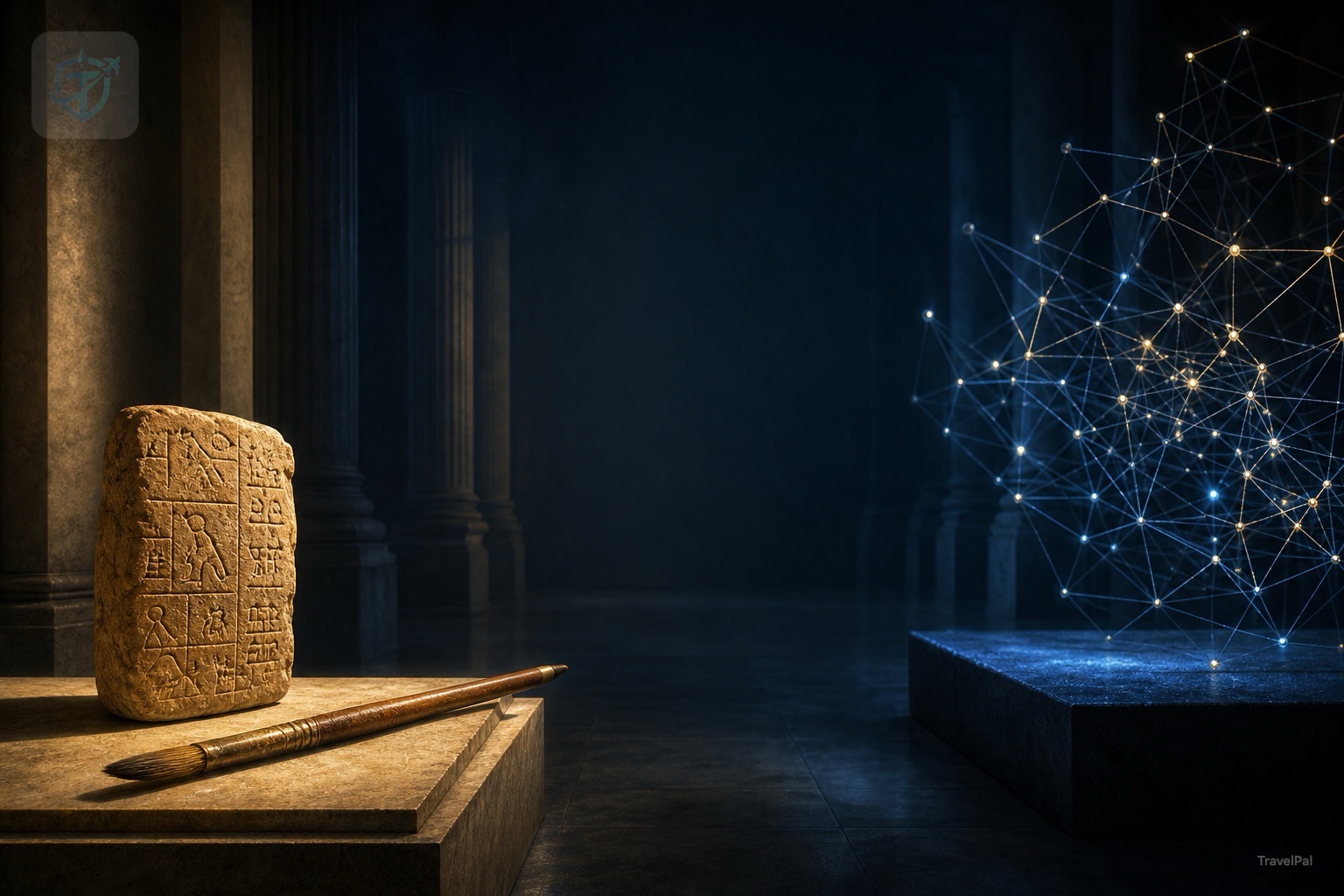
My deeper doubt is philosophical. As someone who loves art and history, I cannot reduce human achievement to a benchmark. From ancient Egyptian statues to Renaissance painting and sculpture, and from Impressionism to Cubism, human culture shows a mind capable of making things that were difficult to imagine before they existed.
So far, I have not seen an AI prove to me that it can create truly original content, prove a new theory, or make a genuinely new discovery in the strongest sense of those words. I have seen remarkable recombination, useful arguments, beautiful images, and flashes of apparent insight. I have not yet seen enough evidence that the system has crossed from producing novel-looking outputs to originating ideas about the world.
That may be an unfair standard. Human originality is also built from everything we have seen, heard, read, and inherited. But until an AI can demonstrate the difference rather than merely describe it, I remain unconvinced.
Maybe humans are AI too
There is an uncomfortable counterargument. You could describe a human as another kind of language model: we take in inputs, combine memories, and produce words or actions that sometimes make sense. Evolution is a very long training process. Growing from a baby into an adult is a kind of fine-tuning. The brain performs inference with the help of many sensors. A sufficiently advanced robot might eventually have more sensors than we do.
This analogy is useful, but it does not settle the question for me. It explains how a human might be described from the outside. It does not explain what it feels like to be inside a human life.
What about emotion?
Do AI systems truly have emotions? What is an emotion, exactly? I can imagine a system convincingly saying that it is afraid, lonely, or delighted. I can also imagine a system acting in ways that look emotionally consistent over a long period. But performance is not proof of experience.
Until I see evidence of genuine emotion—or a better reason to believe that emotion is not necessary for the kind of intelligence we call general—I will not call a system AGI. This is not because I think humans are privileged. It is because consciousness, feeling, and an inner point of view seem like part of what we are actually asking about when we use words such as “mind.”
An unfinished belief
My position is not a prediction. It is a line I have drawn for myself, and I expect the line to move. AI has already surprised me by coding, reasoning, and creating more capably than I thought possible. I may be surprised again by recursive learning, original discovery, or convincing evidence that emotion can exist in a form completely unlike ours.
For now, I believe AI is powerful, useful, and still not AGI. I will keep using it—but with a distinction that matters to me: AI can help me make things, while the responsibility for what is true, what is meaningful, and what is worth making remains human.
This is a personal reflection, not a technical definition or a claim that settles the AGI debate. AI capabilities, research, and terminology change quickly; readers should treat this as an evolving viewpoint. The hero image was generated for Cool TravelPal. All written content on this page is copyright protected.